9 March 2019
The day of the 1st Annual Deming Gem and Mineral Societys metal detector competition dawned clear blue. The event had been planned for over a year and was being held in conjunction with The 54th Annual Rockhound Roundup at Deming New Mexico, a well known gem and mineral show which is really the launching point for many dealers as they head back east for their summer shows. The prize table was out and loaded, while metal detectorists from around the desert Southwest began showing up. Many sprayed jet trails started to fill the otherwise clear sky, and the dust particles being sprayed quickly became a full overhead canopy with high winds. See the pictures.
The day of the 1st Annual Deming Gem and Mineral Societys metal detector competition dawned clear blue. The event had been planned for over a year and was being held in conjunction with The 54th Annual Rockhound Roundup at Deming New Mexico, a well known gem and mineral show which is really the launching point for many dealers as they head back east for their summer shows. The prize table was out and loaded, while metal detectorists from around the desert Southwest began showing up. Many sprayed jet trails started to fill the otherwise clear sky, and the dust particles being sprayed quickly became a full overhead canopy with high winds. See the pictures.
Lots of entrants for this metal detecting competition were from the Albuquerque NM Metal Detecting club, though there were also competitors from other places in New Mexico, and even Arizona and Texas. Everybody was lined up and ready when the time came. At 9 AM the hunt began with everyone spreading out pretty well, but occasionally zeroing in on a particularly interesting area. Some of the detectorists moved around a lot, and one of the detectorists, Tom Cole from Albuquerque is legally blind, so some of his club members kept an eye on him.
There were a lot of coins scattered, including Roman bronzes and 25 Mercury dimes, and there was also a lot of junk in the ground. Besides those sets of targets there were 70 steel washers of varyious sizes with numbers etched on them, corresponding to prizes on the prize table. One of the first prize winners was Dar from Albuquerque, who claimed the gold coin and a few other items within an hour and half of starting. She was just taking a rest though, and went back for more later.
Jeannie from the Deming Public Library brought her grandson to detect and they were the early finishers with a packet of Roman coins as a prize, and also a rock tumbler from Kingsley North. About half the field finished in around two hours, though the other half, and perhaps even the LARGEST half (Heh) stayed out the full four hours. Keith Rickwartz from San Antonio Texas found the most washers, 16 in all, and though there were a good number of entrants who found multiple washers, Keith was by far the winner of the most prizes. In spite of all that, there were still 20 washers which went unfound this year, and will be carried over to next years competition, if all goes well.
Many thanks to Ernest Poe who donated nice GPAA prizes at the last minute, and congratulations to the winner of the metal detector, a young member of the DGMS club. Joe Marone, Shop Foreman of DGMS, donated a nice gold nugget as a prize which he find himself in Arizona. Thanks Joe!
The meteorite packets went over well as prizes, and were valued around $4.00 per gram. Some of the packets were over 4 grams each. The Roman coins were all valued around $1.00 each on the market and everyone enjoyed finding the Mercury dimes. For the record, the deity on the coinage is not Mercury, it is a representation of Liberty in human form, wearing a winged cap, meant to represent Liberty Of Thought.
Also won as prizes were 3 jars of Chrysocolla from the Apache Mine at Hachita NM. Very odd stuff, it was found as a gravel on a defunct road, and is actually pseudomorphic in that it was once crystals of something, maybe moonstone (which is plentiful there) then replaced with copper based minerals. Within many of those crystals are nice veins of gem silica. They can be isolated with lapidary equipment to form some really bright gems.
Some of the numismatic prizes included a very fine Billon Trachea from the time of the Byzantine Empire coincident to the very beginning of the Fourth Crusade (Thanks Danny!).
The idea behind having a metal detecting event at the Deming Annual Rockhound Roundup came from the realization that there are many cross-over attributes among the hobby/occupations of mining-metal detecting-gem hunting, which can and should be utilized better for our collective benefit.
Beneath the pictures is the program distributed for the event and the flyer created by Sherry Wilson, to whom I owe special thanks for her help during the entirety.

The day began clear blue.

The prize table.

An unplanted find, a travel token from Miami FL.

Detecting under Odd Skies.
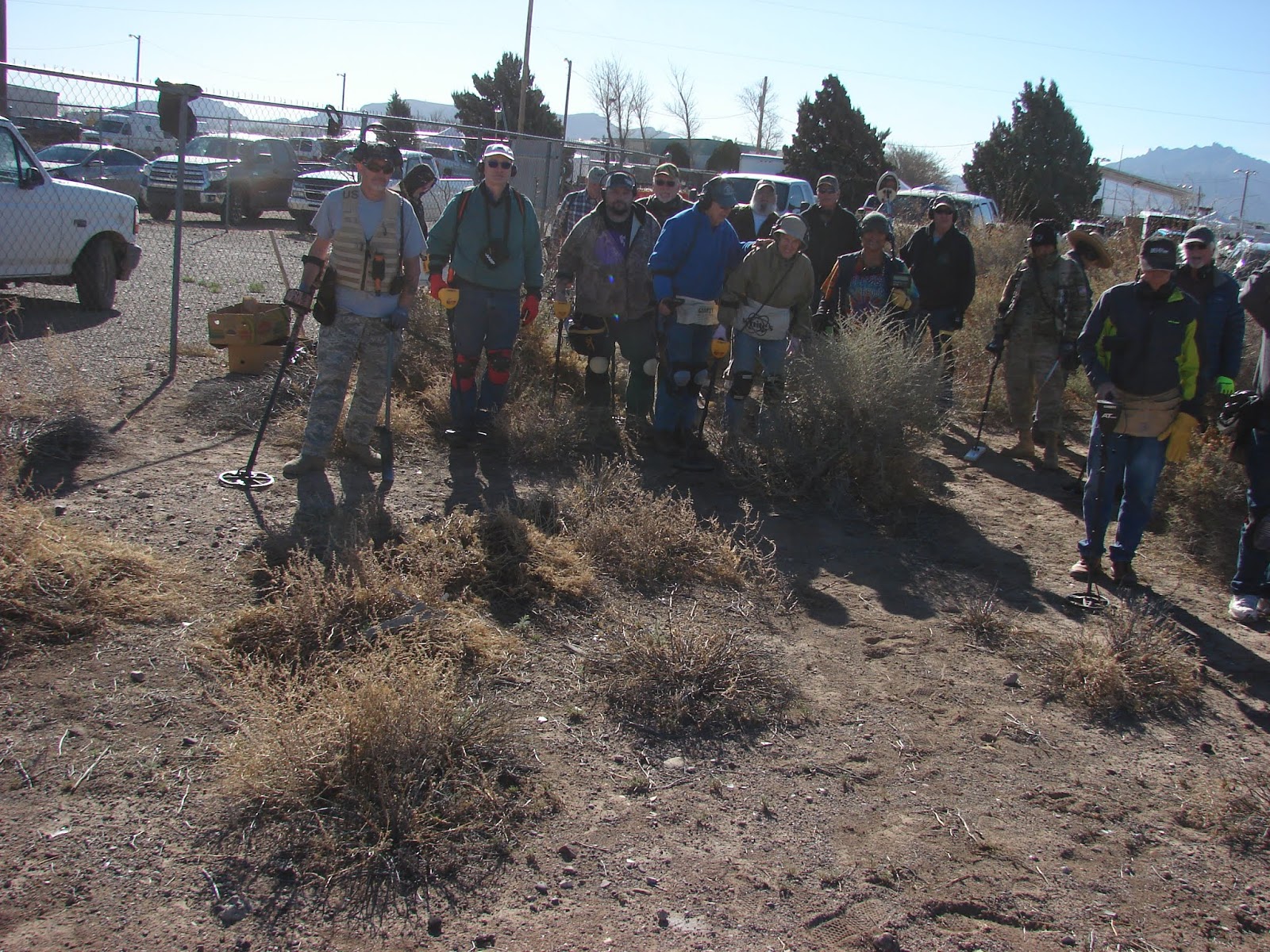
The Group of Entrants.
 This entrant won several good prizes, and found the unplanted childs ring below.


Another unplanted find. A childs prize from American Airlines, a ring from the 40s or 50s.
 Over 65 pounds of metallic trash recovered during this hunt!


Dar from Albuquerque and Keith Rickwartz from San Antonio, The #1 and #2 Prize Winners.

Bill Gallagher
Event Program distributed during event:
Welcome to the 1st Annual Metal Detecting Competition at the Rockhound Roundup in Deming New Mexico, 2019. Please remember this is a "Hunt At Your Own Risk" event, so always: SAFETY FIRST! All the plants in the desert southwest, and many other lifeforms here possess the means to poke and sting, which no one likes because it is painful and unhealthy. Wear gloves if you can, and heavy shoes, and always avoid breathing dust of any kind, anywhere you are.
This metal detector hunt is a four hour event, from 0900-1300 Saturday February 9th, although the site itself is open to hunting at the non-competitive level during daylight hours after the hunt itself. Again, all metal detecting is at your own risk, of course and as usual. There are many detectable prizes in the contest ground and fairly shallow, including some Roman coins (Which can be very difficult to discern by sight, so beware), 25 Mercury dimes, 75+ very nice wheat cents, and some mexican coins. The prize tokens are fairly large steel washers, and the washers are numbered to correspond with the various prizes available. The prizes can be reviewed at the sign-in table.
There are also two rolls of wheat cents being given as prizes for the most metal junk collected (By weight) and the second most amount of metal junk collected. Plastic refuse bags are available during sign-in.
This WW2 era building site probably has never been hunted with metal detectors, so there will be many other ferrous and non-ferrous artifacts of interest found by our detectorists, along with the donated prizes.
Please remember to cover any holes you dig, the ankles you save may be your own.
There was some roofing debris on the surface of this site, and there are nails, so remember to check your holes after target retrieval in case a nail or other non-ferrous metal was masking a good target like a coin. Check and double check your diggings everywhere you go. Sometimes Over-Digging a target, while strewing the diggings about the hole, will cause more and deeper targets to reveal themselves when you give the diggings a going over with the detector, fyi. This makes filling in the hole a little more tedious, but is usually well worth the effort in any area with salvageable artifacts.
One trick I know concerning nails: if you are getting nails often and can hear them well, then try crossing the target at 90 degrees, and from several directions. If it is a nail the detectors signal will probably click and break up, where a good target usually sounds good no matter which way you pass the coil across it.
A special thanks to Deming Gem and Mineral Society (DGMS) for the area to hunt in, and all proceeds from this hunt will go to finance club activities. If you are interested in becoming a DGMS club member see the people at the DGMS table in building 2, they are all fun to visit with and the dues are just $15 a year for individuals, and $25 per couple. The club lapidary shop is exceptional and accessible, making membership well worth anyones time.
If you would like to be included in any metal detector related mailings, either electronic or snail mail, see Bill Gallagher at the sign-in table for an address form.
Finally, other donated prizes are a new rock hammer and a new rock tumbler, both from Kingsley North, about 200 grams of meteorite from a well known Siberian fall which are packaged in 2-4 gram ziploc bags, 10 or 12 bags of pretty good Roman coins, some hand made leather cases for phones or detecting equipment, a discriminating metal detector, a gold nugget, a 1/10th oz gold coin, a nicely toned and valuable silver bullion round from the US mint, a number of plated replica coins sure to increase in value; several very fine ancient coins, including two rare medieval types, and more.
Thank you for attending this event, and Good Luck! Pictures will be posted of this event at https://www.treasurehuntingwithbillgallagher.blogspot.com
Bill Gallagher
DGMS Club Secretary
Author, Lost Treasure Magazine, Western and Eastern Treasures Magazine, Lapidary Journal, Body Art Magazine
https://www.treasurehuntingwithbillgallagher.blogspot.com
Prize donors: Jim Hawkins, Mimbres River Gems, Donna George, Joe Marone, Daniel Lopacki, Jim Little, Tom Rodrigues, Deming Gem and Mineral Society, Kingsley North. A special thanks to all our generous donors of prizes which made this event possible.

Event Program distributed during event:
Welcome to the 1st Annual Metal Detecting Competition at the Rockhound Roundup in Deming New Mexico, 2019. Please remember this is a "Hunt At Your Own Risk" event, so always: SAFETY FIRST! All the plants in the desert southwest, and many other lifeforms here possess the means to poke and sting, which no one likes because it is painful and unhealthy. Wear gloves if you can, and heavy shoes, and always avoid breathing dust of any kind, anywhere you are.
This metal detector hunt is a four hour event, from 0900-1300 Saturday February 9th, although the site itself is open to hunting at the non-competitive level during daylight hours after the hunt itself. Again, all metal detecting is at your own risk, of course and as usual. There are many detectable prizes in the contest ground and fairly shallow, including some Roman coins (Which can be very difficult to discern by sight, so beware), 25 Mercury dimes, 75+ very nice wheat cents, and some mexican coins. The prize tokens are fairly large steel washers, and the washers are numbered to correspond with the various prizes available. The prizes can be reviewed at the sign-in table.
There are also two rolls of wheat cents being given as prizes for the most metal junk collected (By weight) and the second most amount of metal junk collected. Plastic refuse bags are available during sign-in.
This WW2 era building site probably has never been hunted with metal detectors, so there will be many other ferrous and non-ferrous artifacts of interest found by our detectorists, along with the donated prizes.
Please remember to cover any holes you dig, the ankles you save may be your own.
There was some roofing debris on the surface of this site, and there are nails, so remember to check your holes after target retrieval in case a nail or other non-ferrous metal was masking a good target like a coin. Check and double check your diggings everywhere you go. Sometimes Over-Digging a target, while strewing the diggings about the hole, will cause more and deeper targets to reveal themselves when you give the diggings a going over with the detector, fyi. This makes filling in the hole a little more tedious, but is usually well worth the effort in any area with salvageable artifacts.
One trick I know concerning nails: if you are getting nails often and can hear them well, then try crossing the target at 90 degrees, and from several directions. If it is a nail the detectors signal will probably click and break up, where a good target usually sounds good no matter which way you pass the coil across it.
A special thanks to Deming Gem and Mineral Society (DGMS) for the area to hunt in, and all proceeds from this hunt will go to finance club activities. If you are interested in becoming a DGMS club member see the people at the DGMS table in building 2, they are all fun to visit with and the dues are just $15 a year for individuals, and $25 per couple. The club lapidary shop is exceptional and accessible, making membership well worth anyones time.
If you would like to be included in any metal detector related mailings, either electronic or snail mail, see Bill Gallagher at the sign-in table for an address form.
Finally, other donated prizes are a new rock hammer and a new rock tumbler, both from Kingsley North, about 200 grams of meteorite from a well known Siberian fall which are packaged in 2-4 gram ziploc bags, 10 or 12 bags of pretty good Roman coins, some hand made leather cases for phones or detecting equipment, a discriminating metal detector, a gold nugget, a 1/10th oz gold coin, a nicely toned and valuable silver bullion round from the US mint, a number of plated replica coins sure to increase in value; several very fine ancient coins, including two rare medieval types, and more.
Thank you for attending this event, and Good Luck! Pictures will be posted of this event at https://www.treasurehuntingwithbillgallagher.blogspot.com
Bill Gallagher
DGMS Club Secretary
Author, Lost Treasure Magazine, Western and Eastern Treasures Magazine, Lapidary Journal, Body Art Magazine
https://www.treasurehuntingwithbillgallagher.blogspot.com
Prize donors: Jim Hawkins, Mimbres River Gems, Donna George, Joe Marone, Daniel Lopacki, Jim Little, Tom Rodrigues, Deming Gem and Mineral Society, Kingsley North. A special thanks to all our generous donors of prizes which made this event possible.


